This is just me rambling and thinking out loud.
Before I start thinking let me address one point: I'm going to use the term Backgammon. That term refers to one, and only one, variant of the many different games that could be played on a tables board. In the Middle Ages that particular variant was known by many different names, Todas Tablas, Tric-Trac, and Irish to name just three. When I use the term 'backgammon' in this post I'm referring to tables games in general.
Backgammon has a long history in the Islamic world. I find numerous specific references to it dating back to the 10th Century. There were books and poems written about the game, none of which, alas, seem to have survived. I'm pretty sure we're going to find more substantive references to the game as more and more manuscripts become more widely available to members of the public and that's something to look forward to.
We also know, in passing, that the four major schools of the 10th Century all considered backgammon to be haram (forbidden) on various grounds. But books and poems and pictures of princes playing the game! Despite the fact that it was officially forbidden by Islam the game was very popular. And that's one of the very interesting things about backgammon in the Islamic world. And it appears to have carried over to the Christian world in a least one case. If you look at Alfonso X's Book of Games you can't find an illustration of a Muslim playing backgammon or dice. Chess yes, the other games no. Correct me if I'm wrong, I could very well be mistaken. We also know that many of the tafurerias (gambling halls) were located in the Moorish ghettos of Christian Spain.
It seems that backgammon was a tolerated vice that could be cracked down on whenever a new ruler ascended the throne.
Jurists considered that backgammon was haram because it was gambling and because it took time away from the study of the Quran. Counter-arguments were advanced that it was possible to play without gambling. That was countered with the argument that the use of dice made it inherently a game of chance. Curiously, Islam doesn't seem to have adopted the various variations of the game that allow a player to declare his rolls and turn backgammon into a game of pure skill.
A few of the mentions of backgammon that do survive clearly consider that chance plays a strong role in the game. In fact, one of the surviving backgammon origin myths states that backgammon precedes chess and was developed by a courtier to teach an Indian king that a man could only operate within the confines of fate; a fatalistic approach to life. The tale goes on to say that another courtier invented chess to counter the first courtier and teach his king that man controlled his own fate. If this point of view held any sort of sway I would expect backgammon to be far more popular, and licit, than chess in the medieval Islamic world. My personal experiences with Islam have found a strong thread of fatalism within it: Inshallah. The idea that a man can only work within the limits of the will of God would seem a good match with Islam.
Modern Islamic thought has taken a slightly different view. Some of the extreme fundamentalists consider all games haram, some of the traditionalists consider chess okay while games that invoke an element of chance (dice, cards) are still forbidden, and some schools hold that backgammon, and even cards, are allowed so long as they do not involve competition for stakes or take time away from prayers.
We've got illustrations of early Islamic backgammon boards going back to the 14th Century, yet I haven't found a single Islamic example from earlier than the 17th Century and they all seem to follow the Western mode of design. The sole exception is an 18th Century Kashmiri board I found. Absolutely stunning in design and execution and it follows the model of early Persian boads.
One aspect I think we ought to bring to any recreation of medieval Islamic backgammon play is the use of the cup for the dice. The use of the cup, ornate or plain as conditions merit, pleases my sensibilities and sets the game apart, providing us with a trigger that says 'this is not a Western game that I am currently playing'. The use of the cup also argues against the traditional opening of Shesh-Besh where each player throws a single die and the high roller then has to use the dice that have been thrown for his opening move. Shesh-Besh in fact means Six-Five and is the best opening roll possible.
Thursday, August 13, 2015

Tuesday, August 11, 2015
Islamic Backgammon
I finally have enough data points to say I'm confident that a version of modern backgammon (actually Todas Tablas which is slightly different) was played in the Islamic world as far back as the 14th Century. We know tables games, of which Backgammon/Todas Tablas was one version, were played in the Islamic world. In fact, origin tales in the Muslim world claim the game was invented in Persia sometime around the 6th Century. In the 9th Century the Persian/Egyptian poet Abu Nuwas waxed his bad boy credentials by poetically bragging about how he whiled away the days of Ramadan playing chess and backgammon. In the 11th Century the Persian poet Ferdowsi credits Burzoe/Buzurjmihr with the invention mentioned above. We also have accounts from various jurists from the 10th to 17th Centuries who comment on whether or not the game is haram (forbidden to Muslims, and they tend to agree that it is haram).
There are a number of terms for the game depending on when and where you look. The game is called Nard, or some version thereof (narde, nardi, and etc...), in Persian or Frangieh (which apparently means Frankish/French) in Arabic. There are also variations of the game which are mentioned after the 16th Century. I will mention that Mabouseh (mahbusa) is a game popular from the 17th Century to the current day in the Middle East and is played exactly as a game described in Alfonso X's book of games from the 13th Century. It's likely that game was played in the Middle East prior to the 16th Century but I can't confirm that.
Neither can I absolutely confirm that a game almost identical to modern backgammon was played. BUT, the evidence strongly supports the assertion that it was. Let me lay this out for you. Language is tricky and I cannot offer any written evidence that the tables game reference in the writings above is modern backgammon. I have, therefore, relied upon visual sources. There are three images in particular.

Image 1 is a very early 14th Century image held by the Metropolitan Museum of Art. You can see it here. This is a relation of the origin myth of backgammon showing the diplomat/adviser Burzoe instructing the King of India in the game. The game pieces are red and black on a white board (which is interesting in and of itself) and the pieces are distributed in a fashion that very strongly resembles the starting distribution of pieces in modern backgammon.

Image 2 is a close up of a 15th Century illumination in the Anthology of Baysunghur in the Berenson Collection in the Villa I Tatti. Here we see princes playing at tables and, again, the distribution of the pieces very strongly resembles the starting distribution of pieces in modern backgammon.

Finally we have Image 3 which is a 16th Century Turkish illumination depicting Burzoe demonstrating chess to King Khusraw. This piece is held by the Los Angeles County Museum of Art. Note, again, the distribution of pieces.
The distribution of pieces is important because it is unique amongst the games that we know about and we have a fairly extensive knowledge of tables games from European sources. This distribution is highly unlikely, but not impossible, to occur playing any of the other variations of tables games. On this basis I feel confident that someone at an SCA event playing modern backgammon, leaving out the doubling cube and the doubles rule, would not be far wrong at all.
Before I end this I'd like to point out a couple of other things I find interesting. Some of you will have noted the distinctive shape of the boards which visually distinguishes them from European style boards. You may also have noted the cups in the center of the boards in Image 1 and 2. I speculate that this cup was used for the dice and they were either cast into it or kept in the cup and the entire cup shaken and then set down. And last, since all the scenes depict the rich and powerful the boards are, accordingly, quite large. I have no idea what boards for the less wealthy might have looked like. These images don't provide us with any evidence for the number of dice that would be used in play. I suspect two dice were used based on the listing of backgammon equipment provided by the 10th Century writer Mas'udi, but I cannot be certain of this number of the basis of this sparse evidence.
I also want to remind you that I have the rules for many tables games and, more importantly, the sources they are derived from in a PDF booklet here. You can find a set of rules for Todas Tablas, which is the game I believe we are seeing, in this booklet.
There are a number of terms for the game depending on when and where you look. The game is called Nard, or some version thereof (narde, nardi, and etc...), in Persian or Frangieh (which apparently means Frankish/French) in Arabic. There are also variations of the game which are mentioned after the 16th Century. I will mention that Mabouseh (mahbusa) is a game popular from the 17th Century to the current day in the Middle East and is played exactly as a game described in Alfonso X's book of games from the 13th Century. It's likely that game was played in the Middle East prior to the 16th Century but I can't confirm that.
Neither can I absolutely confirm that a game almost identical to modern backgammon was played. BUT, the evidence strongly supports the assertion that it was. Let me lay this out for you. Language is tricky and I cannot offer any written evidence that the tables game reference in the writings above is modern backgammon. I have, therefore, relied upon visual sources. There are three images in particular.
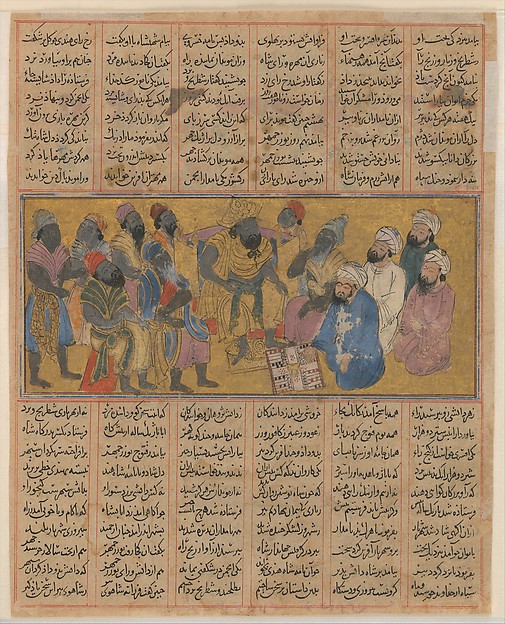
Image 1
Image 1 is a very early 14th Century image held by the Metropolitan Museum of Art. You can see it here. This is a relation of the origin myth of backgammon showing the diplomat/adviser Burzoe instructing the King of India in the game. The game pieces are red and black on a white board (which is interesting in and of itself) and the pieces are distributed in a fashion that very strongly resembles the starting distribution of pieces in modern backgammon.
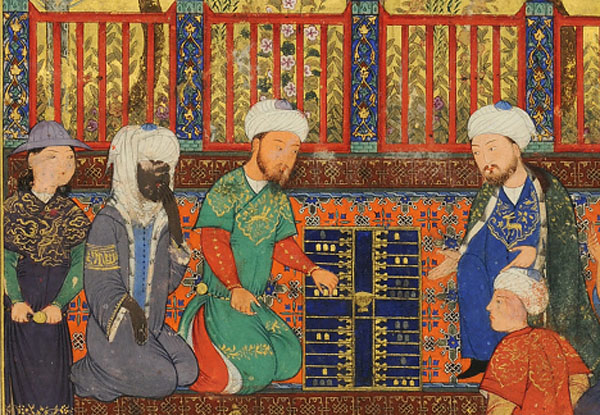
Image 2
Image 2 is a close up of a 15th Century illumination in the Anthology of Baysunghur in the Berenson Collection in the Villa I Tatti. Here we see princes playing at tables and, again, the distribution of the pieces very strongly resembles the starting distribution of pieces in modern backgammon.
Image 3
Finally we have Image 3 which is a 16th Century Turkish illumination depicting Burzoe demonstrating chess to King Khusraw. This piece is held by the Los Angeles County Museum of Art. Note, again, the distribution of pieces.
The distribution of pieces is important because it is unique amongst the games that we know about and we have a fairly extensive knowledge of tables games from European sources. This distribution is highly unlikely, but not impossible, to occur playing any of the other variations of tables games. On this basis I feel confident that someone at an SCA event playing modern backgammon, leaving out the doubling cube and the doubles rule, would not be far wrong at all.
Before I end this I'd like to point out a couple of other things I find interesting. Some of you will have noted the distinctive shape of the boards which visually distinguishes them from European style boards. You may also have noted the cups in the center of the boards in Image 1 and 2. I speculate that this cup was used for the dice and they were either cast into it or kept in the cup and the entire cup shaken and then set down. And last, since all the scenes depict the rich and powerful the boards are, accordingly, quite large. I have no idea what boards for the less wealthy might have looked like. These images don't provide us with any evidence for the number of dice that would be used in play. I suspect two dice were used based on the listing of backgammon equipment provided by the 10th Century writer Mas'udi, but I cannot be certain of this number of the basis of this sparse evidence.
I also want to remind you that I have the rules for many tables games and, more importantly, the sources they are derived from in a PDF booklet here. You can find a set of rules for Todas Tablas, which is the game I believe we are seeing, in this booklet.
Tuesday, June 16, 2015
Tables Games
As I've noted, my commonplace book of a blog has become more of a diary than an actual commonplace book. That function, gathering together useful bits of information, has been taken over by Google Drive. I really like Google Drive.
But in looking back on my posts (both of them) I saw that I had started talking about backgammon and tables games and never really finished. I have finished. I've compiled a bunch of references and learned quite a lot about tables games in the Middle Ages. Long before playing cards make their appearance in the 14th Century and become wildly popular in the 15th tables games were cock of the walk. Chess, being entirely based on skill, was popular primarily with the upper classes. Dice, being entirely based on luck (unless you were cheating), was popular primarily with the lower classes. The relative costs of the gaming equipment required helped to cement this. Tables games, on the third hand, combined elements of chance and skill in varying degrees and were wildly popular with both segments of the population.
I've compiled the rules for 19 distinct tables games (which includes Backgammon) and an additional 5 variations on those games. My list is by no means exhaustive but I think I've hit on the more common games and variants for which rules are available. Rather than type everything out, again, I'm just going to point you to the booklet I prepared:
https://drive.google.com/file/d/0B15SAMYZtejMV3VVNllCME95U2M/view?usp=sharing
And now I'll offer some random comments:
-Although it seems strange, I really like the games that allow you to declare your rolls rather than actually rolling dice. While this eliminates chance from the game, it's very interesting to occasionally play tables games as exercises in pure skill.
-I was fascinated to discover that people would set up tables game problems, like chess or go problems, and then wager that people couldn't solve the problems. These were, again, pure skill puzzles and trying to understand and solve them seems like an exercise in touching the middle ages.
-Although the booklet doesn't cover game boards, I think finding the wide variety of gameboards out there was one of the bigger pleasures of my research. They varied from humble scratchings on wood and ivory to massively inlaid treasures. The variations in design were also interesting to see.
-The sheer variety of games, and the complexity of the rules, was astounding. The booklet was less an attempt to share my research than it was to make a document I could refer to in order to refresh my memory when I wanted to play a game. In looking at these games, and early playing card games, I am struck by how much time the players must have been taking. In general it seems that the idea of a quick game was known but not entirely popular.
-Fallas threw me for a loop. I didn't understand it at all until I realized it's a game that's played to not lose rather than to win. I've never played a game of this that ended with someone getting all their pieces off the board. Positioning yourself to have lots of moves, and to take away your opponent's ability to move, is the object of the game and players who realize this tend to win.
-I *REALLY* want to find a documented game from the Islamic Middle Ages. We know the game was played (my favorite reference is a poet establishing his bad-boy cred by boasting about how he whiles away the days of Ramadan playing tables games) but we don't know the exact rules of any of the games they played. I used two modern games with long established (18th Century) roots and one game I made up by using common rules and a starting position found in a 14th Century Persian illustration.
Monday, June 15, 2015
More playing cards. Paper, again.
Remember how I said the paper in playing cards was linen? Yeah, about that... With the caveat that we're talking about a very large geographical area and time frame: I was wrong. Linen is only number two on the list of materials. It appears that hemp is number one on the list. I thought that linen rags constituted the largest ingredient that went into making paper but in fact it's the hemp material from sails and, more importantly, ropes that constituted the largest ingredient.
Again, big time frame and geographic area, but it appears that hemp is far and away the primary ingredient, supplemented by linen, and then by various other materials. In every case the materials that went into paper were waste materials from other processes or products. Mulberry material has been found in some papers, for example, and this was probably waste from the silk industry in Southern Europe. Cotton fiber is mentioned as an ingredient, but the tow (the short fibers) rather than the long fiber material (called flax fibers) used for making clothing. This from a source on Islamic paper composition. I've even heard allegations, but not yet seen the references for myself, that hair and other waste fibers from animals went into paper production.
While the natural inclination, okay, my inclination, would be to assume that such paper would be rough and very much off-white and possessed of numerous irregularities this was apparently not the case. Pulping was a very organized, if labor intensive, process with strict quality control. Bleaching was a known process and was practiced. Water was filtered to prevent contaminants from entering the process. Paper was pressed, rolled/polished, and even given surface finishes using chalk. One of the English conservation organizations I looked at noted that medieval paper, when new, bore a strong resemblance to 80gsm white printer paper in appearance and texture. Colored paper was even in use.
Yeah, I know, you want references. This blog isn't really about those; it's more of a place where I collect and share some of my thoughts and ideas. Here are a few links:
http://paper.lib.uiowa.edu/european.php
https://www.saudiaramcoworld.com/issue/199903/revolution.by.the.ream-a.history.of.paper.htm
http://www.islamicmanuscripts.info/reference/books/Gaur-1994-Calligraphy/Gaur-1994-Calligraphy-032-055.pdf
http://britishlibrary.typepad.co.uk/collectioncare/2015/04/making-islamic-style-paper.html
http://www1.uni-hamburg.de/COMST/Bulletin1/pp69-70.pdf
I've been working with playing cards for several years now and I'm approaching what I consider a position of enlightened ignorance (I'm becoming aware of just how little I actually know). I have experimented with techniques and I continue to experiment with techniques and I'll share some of the results here when I have the time and inclination. For the past few years I've sort of been confined to doing print on demand using modern printers and modern materials. Now I'm looking at moving past that and producing cards that are printed on paper that's more closely authentic. In that search I've been looking for hemp, linen, and cotton papers of 300gsm that's not a brilliant white and is mostly smooth/polished. It's been difficult to find at reasonable prices. There are any number of high-end craft manufacturers out there who have been in business since the 17th or 18th centuries and will charge you accordingly (or so it seems) but more affordable paper has been hard to find. Still, I keep looking.
I'm updating this because I've done more research but I don't want to start a new post. I read a good analogy: Trying to describe paper-making during the Middle Ages is like trying to describe cheese-making during the Middle Ages. That really sums it up. Indications are that paper-making was a sophisticated process (which means it had a lot of techniques to choose from and lots of ways those techniques could be varied) and the products produced by paper-makers could vary widely, even from the same manufacturer. The documented sorting of fibers meant that manufacturers typically produced at least three grades of paper. Treatment options for rags prior to pulping could lead to large variations in color. Variations in sizing (soaking the paper in gelatin and, possibly, other substances) could lead to differences in appearance and the way the paper reacted to inks. And post manufacturing treatments such as burnishing could produce different textures. All of this means that there's no effective way to say what paper for Medieval playing cards should have looked like.
I'm updating this again. Remember, kids, always check the references. Always.
http://paper.lib.uiowa.edu/index.php#
This website has a link to their collection which has a large sampling of historical papers from the 14th Century on.
http://digital.lib.uiowa.edu/cdm/search/collection/paper/order/date
In looking through this I find that the average thickness of 14th-15th Century papers is: 0.22mm
Now I can check that with a reference source on paper weight (thickness).
http://www.paper-paper.com/weight.html
That tells me the paper in question is about a 199gsm
For comparison that's a modern cardstock. That's almost as thick as the cardboard that makes up a box of breakfast cereal. Because it is paper, not cardboard, however, it is considerably less stiff. This is not as thick as premium calling-card stock, for instance. By way of comparison, common copier/printer paper is usually around 70gsm. That means these historical sheets of paper are almost three times as thick.
Faux Ivory Inlay
The 14th Century (The One, True Century) was the ivory age. Just about anything that could be made of ivory was. If it wasn't made with ivory it was adorned with ivory. There are a lot of fascinating political and economic insights to be drawn from this but that's not what I'm here for. I'm going to talk about some of the difficulties this presents in recreating aspects of material culture and I'm going to talk about some ways to overcome this.
If you are a strict recreationist you need to stop reading now. You see, all faux ivory is plastic. There are exceptions, tagua nut makes a fine ivory alternative and so does bone. Tagua nuts are small and really unsuitable for inlay or larger works. Bone is the preferred alternative and was in the middle ages. There are even laws prohibiting people from passing bone off as ivory. So if you really want to be highly accurate in your portrayals/recreatons, bone is the way to go.
I have found bone to be difficult to work with. The dust needs to be kept out of your eyes and lungs, the smell of it when cutting is unpleasant, and it's a fairly brittle material particularly when you cut it very thin as you need to do for inlay. It's quite durable once it's inlaid, but getting it to that point... I lack the skill and patience. Plus, bone comes in very narrow sheets. If you want to make a larger piece you're going to have to join several sheets to make a large enough sheet to work with. This is authentic. And a pain in the ass.
Remember how I said that all faux-ivory products are plastic? Yep. You can buy very nice sheets of the material from many sources. But it's plastic. You can cast in ivory resins. Again, plastic. And you can use putties. Plastic again. But I find the putties are generally superior to all of the above because you can create the striations and imperfections of color found in real ivory rather than getting a uniform 'ivory white' plastic. The trick is to look for the online tutorials on making faux ivory using Sculpey modeling clay. You will find multiple approaches to this.
The technique I have used the most often involves inlay. Simply put: I used a laser to make a channel in the piece of wood. I then applied a thin bead of epoxy (super glue) within the channel. Then I pushed my ivory colored sculpey clay into the channel. I let the sculpey air dry hard then sanded the excess away. I baked the piece in an oven at low heat to harden the sculpey and I oiled the piece with linseed oil straight out of the oven to avoid cracking/warping.
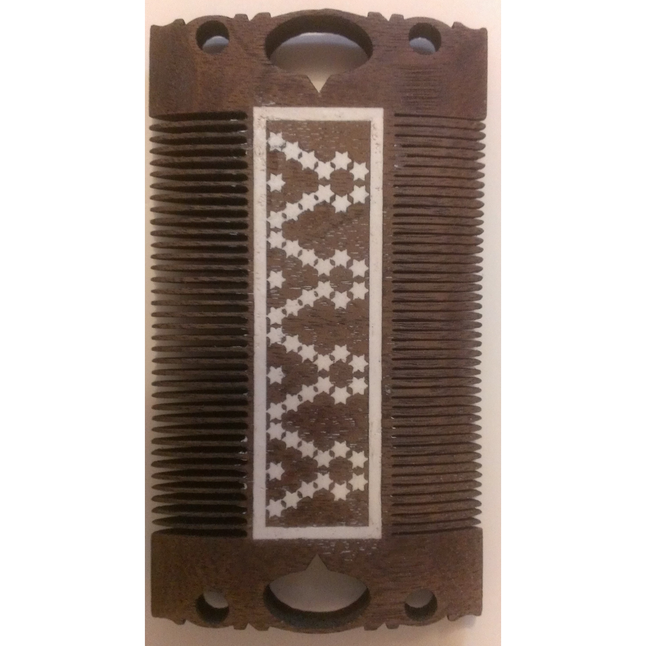
This produces a very nice faux-ivory inlay in small applications. Here's a comb I made using this technique for the inlay.
If you are a strict recreationist you need to stop reading now. You see, all faux ivory is plastic. There are exceptions, tagua nut makes a fine ivory alternative and so does bone. Tagua nuts are small and really unsuitable for inlay or larger works. Bone is the preferred alternative and was in the middle ages. There are even laws prohibiting people from passing bone off as ivory. So if you really want to be highly accurate in your portrayals/recreatons, bone is the way to go.
I have found bone to be difficult to work with. The dust needs to be kept out of your eyes and lungs, the smell of it when cutting is unpleasant, and it's a fairly brittle material particularly when you cut it very thin as you need to do for inlay. It's quite durable once it's inlaid, but getting it to that point... I lack the skill and patience. Plus, bone comes in very narrow sheets. If you want to make a larger piece you're going to have to join several sheets to make a large enough sheet to work with. This is authentic. And a pain in the ass.
Remember how I said that all faux-ivory products are plastic? Yep. You can buy very nice sheets of the material from many sources. But it's plastic. You can cast in ivory resins. Again, plastic. And you can use putties. Plastic again. But I find the putties are generally superior to all of the above because you can create the striations and imperfections of color found in real ivory rather than getting a uniform 'ivory white' plastic. The trick is to look for the online tutorials on making faux ivory using Sculpey modeling clay. You will find multiple approaches to this.
The technique I have used the most often involves inlay. Simply put: I used a laser to make a channel in the piece of wood. I then applied a thin bead of epoxy (super glue) within the channel. Then I pushed my ivory colored sculpey clay into the channel. I let the sculpey air dry hard then sanded the excess away. I baked the piece in an oven at low heat to harden the sculpey and I oiled the piece with linseed oil straight out of the oven to avoid cracking/warping.
This produces a very nice faux-ivory inlay in small applications. Here's a comb I made using this technique for the inlay.
You can see the inlay worked particularly well against the darkness of the walnut. With care this process could be used for larger pieces such as tables boards (backgammon). I don't think this would be suitable for items that stand alone. The clay is significantly lighter than real ivory and lacks some of the feel. It's also substantially less durable and prone to snapping. This isn't an issue when it's inlay.
Friday, May 22, 2015
Playing Cards
I've been interested in playing cards of late. Perhaps I should say 'more interested'. I've been interested in playing cards for a while now and I made two attempts at crowd-funding two decks. Two really horrible decks. Two embarrassingly bad decks. Words fail me. And I knew it at the time which is one of the reasons I stepped away from playing cards. The other reason was that I was able to make a lot of different things and cards kind of went on the backburner.
Since then I've gotten moderately better at this. I still have all the artistic talent and skill of a rock, but through study and practice I've come to learn what Medieval/Renaissance playing cards should look like. And since I no longer had the ability to make the physical items I had been crafting it made sense to turn back to playing cards. Playing cards can be done with minimal resources and the greatest challenge is getting the composition correct. One area of the composition has consistently eluded me, however. The paper. We know the cards were made of paper. We know the paper was rag paper. We know the rags were linen. We know the paper was glued together in layers. We don't really know how thick the cards were. I blame the museums.
That's kind of a harsh statement to make and the museums might be forgiven this lapse for two reasons:
1) The cards are so thin that they need to be measured with calipers and measurements are probably in fractions of a millimeter (microns, in case you're wondering) and early collectors simply didn't take measurements of that sort. When the collections went to museums the staff probably just confirmed the existing data and moved on.
2) They've put SO MUCH information online. I have over 156 pages of notes, references, and images culled from the internet alone. That doesn't count the multiple gigabytes of data in the form of PDF files and other images. And if you add in the publications that are available to just about anyone with access to the library system of a major city and/or university... well, the world's your oyster.
So I forgive them. But I'm asking them to supply the information because it seems important. I'll talk more about that another time.
We know the definite thickness of two historical decks: the Ambras Hunting Deck and the Morisca Deck. The Ambras Hunting Deck is from the 15th Century and is extremely ornate. Each card is a hand-made painting. And the cards reflect this. Each card was prepared with a layer of gesso on the front. Possibly more than one. And the gesso was sanded and polished after it dried and then the paint was added. Consequently, each card is about 1mm thick. That's as thick as four modern playing cards stacked on each other.
The Morisca Deck dates from the very beginning of the 15th Century, possibly as early as the last decade of the 14th Century. The paper is very fragile and degraded and the cards have been glued to a backing in order to preserve them. The cards themselves are, at their thickest, 180 microns. That's 0.18 mm. That's about 75% the thickness of a modern playing card. That's slightly thicker than a dollar bill (which is also a linen paper and, so, a good comparison).
Remember that playing cards are made by gluing together multiple sheets of paper. This is necessary to achieve a degree of opacity so that players can't see the faces of the card through the backs. Solving this problem was one of the biggest issues facing cardmakers and the inability to produce a reliable back that looked the same on all 52 cards vexed them for almost a hundred years with lots of solutions being tried.
But that's a different discussion. Back to the construction of playing cards. Multiple layers glued together. But still very thin. The paper being glued together was probably about the thickness of a cash-register receipt. I consider it pretty impressive that they were making paper that thin. Every time I try to make paper it's pretty darn thick. Four or so of these sheets were glued together to form the stock upon which the cards were printed. To my mind this means the glue played a large role in determining how stiff the cards were.
There's no definite word on what types of glue were used until the 17th Century when wheatpaste was the glue of choice. I found a record from the 19th Century that said you got a gallon of glue from a pound of flour. And we know from 18th Century illustrations and descriptions that paper was glued together and then compressed in a press to get the excess liquid out. I think this process, and the linen paper used, went a long way towards making a stiff playing card. Possibly stiffer than we're used to.
So how thick were the cards, really? I've always thought they were thicker than modern playing cards because I assumed they were made on a thicker (cruder is the word I want to use) paper. But that might not be the case. Until I can get the museums to measure their cards I won't know for sure, but I was able to find multiple images of decks. Some of the earlier decks were thicker, but not all. And by the time I hit the 17th Century and what I consider reliable depictions I find that old decks were about the same thickness as modern decks.
The answer seems to be: it varies. In other words: there is no single answer. I look forward to seeing what measurements come back from the owners of the surviving cards.
Friday, April 17, 2015
Uh....
Yeah, almost two years since I last posted. I blame Google Docs. You see, I haven't not been doing any research. Research is about ALL I have been doing. Tables boards, pieces, rules. Cards, designs, games, and etc... Pottery. 3-D printing medieval buttons, and belt buckles, and mounts, and strap ends, and....
But why do I blame Google Docs? Because that has become my new commonplace book. As I search the internet I find images and references and documents and I grab that info and add it to a new Google Document. The main document of references I maintain on playing cards is over 150 pages long, currently. The associated files not contained in the document account for a little over 6GB. It's gotten to the point that I take pictures of items with my phone and upload them rather than trying to keep physical copies. And thanks to free scanning applications I can even translate pictures of text to text. Image viewer doesn't allow me to download a zoomed view of a medieval document? Alt+Printscreen, GIMP crop, and voila. God but I do love this modern age!
Of course, it's not all sunshine. But the clouds are mostly of my own making. When I started this (combs, I'm looking at you) I just grabbed the photo and moved on. And a couple of weeks later when I wanted to go back and do more research I had failed to note where the picture had come from and it took me a while to find it again. If I could. Yep, some pictures I've never found again. Even using the Google photo search capabilities.
So now I get the picture (really, just drag it from the screen to the Google Doc), I get the URL of the picture and put it beneath the picture, I get the URL of the page the picture appears on, and then I grab descriptive text from the page and/or add my own notes. In effect, building my own annotated reference bibliography. If the file is a PDF then I grab the info regarding that file in the same fashion and download the PDF file to Google Docs and then I add a link to my copy of the file. Voila.
Finding the information on the internet has been... interesting. There is a lot of information to find. If you aren't a member at your local museum, become one. Or join a museum you like. Because museums are digitizing their collections and making them available online and it's amazing what you can find if you're patient enough.
I separate internet searches into two levels: surface and sub-surface. Surface searches are actually enormous in scope; they are everything you can find in a Google search. The sub-surface searches are the databases accessible through the internet but not through Google itself. I usually use Google to locate these sources and then go to them and see what they hold.
Surface searches. There's a vast amount of information to be found on the web. Google will help you find it. The first thing you need to do is figure out what you're looking for. While this sounds simple, it's not always the case. The best information is frequently found in professional sources and professions sometimes have different names for things. Compile a list of your search terms and start looking. Try mixing them up. Now do the same thing in different languages. If you're researching playing cards you're going to need to use German search terms to find a lot of the best information, for example. Google Translate is your friend in finding these search terms and in getting the gist of what the foreign language documents are saying. BUT, you need to look at the foreign language documents in their original language to find more search terms.
A good way to find information rich sources is to limit the filetypes you are searching. Google will allow you to specify. My favorite document type is a PDF. This file format is the favorite of museums and researchers and document digitizers. That makes it particularly likely to contain high-quality information. I simply end any Google search with filetype:PDF and it will show me only PDF files.
Another way to quickly assess the results of a search, particularly for a foreign language, is to use the image search in Google. While it can be hard to determine if a Greek document is worth looking at on the basis of the Greek text description returned by a typical Google search, if I see an image the site contains that has, for instance, a comb, then I know I've found something worth looking at. You can also right click on a photo and have it search for other instances of the same photo (great for finding other pages that you're looking for) and visually similar images (not usually a winner but sometimes you hit the jackpot).
This process is easy to get lost in so it's good to take notes along the way. Remember what search terms you're currently using (write them down). Take notes of search terms you want to use: words, phrases, books, other references.
When you find a site that looks like it has multiple references, mine it. Google will allow you to search a specific website. Site:www.example,com will search only that site for your search terms. Sometimes you aren't meant to see other web pages within a site. You can sometimes circumvent this. Try removing the name of the webpage from the website URL and see if you get access to the info within. Example: www.example.com/motherlode/example.html becomes www.example.com/motherlode/ Fewer and fewer web administrators make this mistake, but sometimes they do. Is this hacking? Not according to the legal opinion I sought out a couple decades ago. Honestly, this technique is mostly useless these days as the Google web-crawlers tend to find these resources. But sometimes you turn over a rock and find cool stuff.
Sub-surface searches are more likely to be information rich but they can be difficult to locate sources and harder still to get access. WorldCat is a good example of a readily available database. Google does not index WorldCat so while you can find it with Google, you can't search it. WorldCat is a worldwide catalog connected to hundreds of libraries worldwide. You can use it to search in much the same way you search Google. It not only references books it references articles and online resources. It's also a great resource for Inter-Library Loans. My two library accounts allow me to sign in to World Cat from the library website and make an ILL request directly from WorldCat. My library memberships also grant me access to different databases referenced by WorldCat. A university membership might come with access to different academic databases, for instance. You'd be surprised at the places you can get membership. A one year reader's card for the Oxford Library System (hello Bodleian!) is 40 Pounds.
Museum and University sources are also great sub-surface sources to search. Many European institutions, including libraries, are digitizing their holdings. The Denver Public Library has a large database of photographs from the late 19th Century American West, for instance. I like to identify institutions that hold resources I want to examine, based on my previous searches, and then go to those sites and see if I can search them. Frequently they are free. More frequently you can get access for a small fee, particularly the European institutes. Sometimes you just need to access the database from the right source (hint: institutions which offer free access, usually European, or institutions at which you have a membership).
The databases are information rich but sometimes very difficult to search. Google Translate is your friend in finding the database, but once you're in you're generally going to have to navigate in the language of the database. Translate will help you still by allowing you to translate individual terms. It helps to think of it as an adventure. Remember that bibliographies are a great comfort in times of search. And try to come at problems from a different angle. I have found, for instance, several books that were rather expensive available for download free of charge. Why? Because they were the Master's or Doctoral theses of the authors and were published by their Universities.
Be creative, be persistent, and have fun. And that's all I've got to say about that at the moment.
Subscribe to:
Posts (Atom)