Friday, October 30, 2015

Stuckely Playing Cards

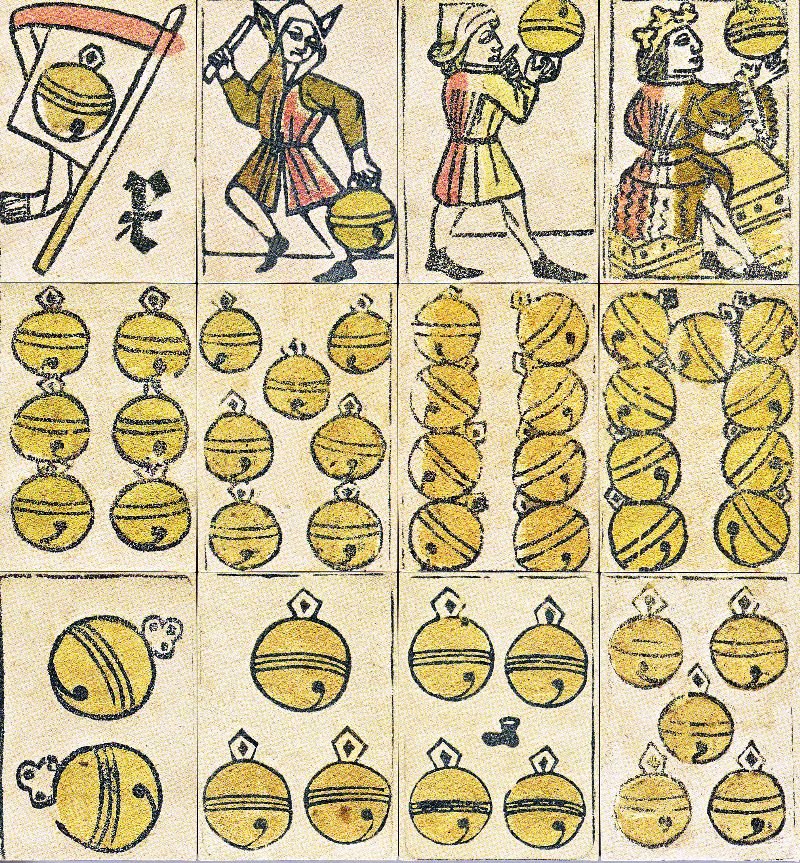
More playing cards!  One of my favorite decks is in the holdings of the British Museum.  These are referred to as the Stuckely Decks after the man who exhibited them to The Society of Antiquaries in 1763.  The cards themselves were collected by Dr. Thomas Rawlinson at an earlier date.  They came to the museum through the collection of Lady Charlotte Schreiber.  You should remember that name if you're studying early cards.  Look it up.

This particular portion of the collection was put together in the 18th Century and contains three sets of cards.  The first is a badly degraded deck dated to the late 15th Century, the second is an 18th Century watercolor recreation of the deck done using alternate colors, and the third is the court cards of an 18th Century French deck.

The first set can be viewed here:


The second and third sets can be seen here:


As you can see, the second set is a later copy (18th Century) of the first set which dates to a much earlier time (15th Century).  Because the second set is in much better condition I elected to re-create that deck first.  I retained the original colors because it seemed like the thing to do and because I was intrigued by some of the color choices the 18th Century copyist had made.  The decision to give the court figures red hair (instead of the usual yellow or black) was particularly intriguing.  I mentally dubbed this deck "The Redheads".

I have all the artistic skill of a rock.  Well, maybe not a rock, but I'm not a skilled artist.  My usual modus operandi when faced with a deck like this is to preserve as much of the original work as possible.  So I downloaded the images and set to work. I cleaned up as much as I could and then began the work of digitally restoring the cards.  The background had to go.  It was simply too dirty.  On the other hand people seem to prefer the 'olde tyme' look (and, yes, I'm saying that with a little bit of derision).  I opted for a darker version of a natural paper coloration.  Don't get me started, again, on paper in the Middle Ages; let's just say I should have gone with a lighter background.

I had to recreate the pip cards.  I did this by taking the cleanest examples of elements I could find and cleaning them up a little more.  Then I cut and pasted those elements to recreate the pip cards.  I added an ace to each suit because it allows modern players to play modern games with the deck.  The actual deck, as is typical of German style decks of the time, didn't have an ace.  I simplified the two of acorns and leaves.  This wasn't simple laziness on my part.  I got a fairly nice unicorn prepared and then decided I preferred a cleaner representation AND I wanted to make sure my replica didn't get confused with any reproductions the Museum might care to produce in the future.

The courts were more difficult.  They were pretty messy to begin with and the unter of bells was missing altogether.  I altered a copy of the ober of hearts to make a new unter of bells.  Not my finest work but I think it's pretty good.  I cleaned up a lot of the faded coloring.  My favorite moment working with this deck occurred during this process.  As I altered the contrast of the unter of acorns, the archer, the dingy blue colors revealed themselves to be greens.  That was awesome.  Sort of.  Because then I had to go back and alter the entire suit of leaves (which I had already done) to match the greens of the archer.  I'm glad I did because it made the entire deck much nicer, but it was one of those moments where I wished I'd gotten it right sooner.

The results can bee seen in this sample image:


I had to give the cards wider borders.  Why?  Modern printers demand it and it's fairly easy for me to modify the deck if I want to do my own printing.  I elected to give the deck a plain back.  I would have told you that decorated backs appear very late in the history of cards (18th Century) but I'd have been wrong.  Cards were getting decorated backs almost from the very beginning.  In this case, however, with no examples to draw from I elected to go with a plain back.  It was the most common back choice.

Next for this deck is restoring the original color scheme and putting the correct unter of bells in.  When I do that I plan to lighten the color of the background a little because medieval paper makers were quite proficient and the yellowed texture above just doesn't reflect their abilities.

Tuesday, October 13, 2015

At a loss for words

As the title says, I am at a loss for words.  I found out a couple of days ago that Will McLean, Galleron de Cresy, was very ill.  Yesterday I found out his battle with cancer had taken a turn for the worse and he was home and in hospice care.  Well... home and in hospice care AND with plans to go to a local event and portray a convalescent.  Probably with the same thoughtfulness and dedication to historical accuracy and inventiveness that he brought to pretty much everything I saw him do.

Not that I ever got to see him in person.  Not that I'm aware of.  I knew of him through the internet.  He introduced me to the idea of commonplace books.  To the ideas behind the forms of tournament combat.  To the fun of historical recreation.  And I know he had similar, and greater, effects on many other people.

The saying is that a man's not gone while people still speak his name.  Will McLean will be around for a very long time.  God keep him and comfort his.

Tuesday, August 18, 2015

Playing Cards - Swiss and German

I started researching playing cards because I wanted some cards that were appropriate for late 14th Century Spain and I particularly wanted to have cards that were appropriate for both Christian and Muslim Spain.  That led me to the Mamluk deck held by the Topkapi museum in Istanbul which led me to... Switzerland?

Pretty much.  I'm fond of saying that you can learn a lot about something by looking at its shadow and in this case that meant broadening my search to move away from Islamic/Spanish playing cards to Medieval/Renaissance playing cards in general.  Which turned up this:

Image 1


Image 2

These are part of a 16th Century deck from Basel.  You can find variation on this design from the 15th to the 18th Centuries and they've been reprinted in the 20th and 21st Centuries.  And once I started trying to understand this deck I was lost.  You see, the Swiss and the Germans took to playing cards with a zeal that doesn't border on ferocious because ferocious is so far back in the rearview mirror you couldn't see it from the top of a very high peak.  I've counted over 27 different suits used in Swiss/German cards from the 15th to 17th Centuries and I'm positive I haven't found them all.  The study of playing cards really is something of a rabbit hole.

This deck was unique in that it was complete.  That's a rare thing to find.  There can't be more than ten decks from before the 17th Century that are complete.  There are a lot of partial decks (and partial cards, for that matter) but none are complete.  And the imagery of this deck appealed to me.  Probably because it's very simple in comparison to some of the other decks.  So I decided to make some.

Early experiments were interesting. I quickly determined that hand drawing these cards was not going to work for me.  Almost as quickly I determined that making these cards on authentic paper, with proper paints was a) beyond my artistic skills and b) going to be very expensive.  That wasn't good.  I wanted to make a little money at this, yes, but I also wanted a bunch of people to be able to use these cards.

Image 3

Image 4

In Image 3 and Image 4 you can see some cards I made in a compromise technique.  I printed the designs onto 150gsm paper (a cardstock) and then glued the printed sheet to a backing sheet to make a 300gsm sheet of cards that I then cut out by hand.  All I can see here are the failures.  The unter/under/jack of bells in Image 3 clearly shows the cards are too large in relation to the artwork.  In Image 1 we can see the artwork nearly fills the entire card and in other surviving decks/cards we can see the artwork is sometimes cut off because it was so close to the edge.  These cards were way too thick.   I think.  We don't have a lot of information on how thick the cards actually were, but I think these are way too thick.  They're also black and white.  If you see a surviving deck in black and white that's because it was a printer's reject sheet that was recycled for something else.  Cards were colored.  By hand, by stencil, by whatever method.  But they were colored.

Ultimately I decided to go with a professional printing service.  I chose a print on demand service because I had no money to pay for a small print run (500 decks).  That drove up the cost of each deck but kept the price fairly low and allowed me to ensure the cards remained available without having to do another print run if I ran out of cards from the first run (ha!).  After experimenting I ended up choosing Printer's Studio and got my first set of cards.

Image 5

I like the way the cards turned out, but everything about them is a problem.  The colors are perceived by customers as being too bright.  I'll admit the palette could benefit from some tweaking to more closely approximate surviving examples, but indications are that Medieval painting *was* quite bright.  The cards are too white for a lot of people; they don't convey that 'olde tyme' feeling that sepia-toned paper does.  Again, Medieval paper was frequently coated with a mixture of starch (binder) and chalk (pigment) to make it whiter and smoother.  Frankly, Medieval paper was frequently of a higher quality than the wood pulp stuff we commonly use now.  The margins around the artwork were unavoidable.  Modern printers simply won't accept the losses that Medieval printers were willing to accept and they demand quite a large margin around the artwork.  The rounded corners are, in my mind, even worse.  Medieval playing cards had square corners.  This deck has a patterned back.  That's one of the benefits of using a professional printing service.  I could never have done uniform backs on my own.

Image 6

In Image 6 you can see 10 of the almost 30 suits I put together from documented examples.  Well.... almost.  When I made the swords and coins I thought I was being.... creative.  You see, swords and coins are part of the Latin-style card decks and aren't Swiss/German at all.  Except they turned out to be Swiss/Italian and very well documented.  I've changed the designs and the layout to more accurately reflect the historical examples and added cups and batons/staves as well.  To the right you can see some examples of card backs that I experimented with.

So what are you seeing?  The Swiss/German deck layout typically has pip cards (the number cards) from 2 to 9.  There is no one/1/ace.  In the Swiss influenced decks the ten is typically a banner bearing the suit symbol and an X serving as a Roman numeral ten.  In the German influenced decks the ten is generally another pip card (ten suit symbols) with a Roman number ten somewhere on the card (typically the middle of the card or the top of the card).   The ten in both decks frequently serves the same purpose as the ace in modern decks.  In the example above you can see modern style aces.  I added those to make the deck more flexible; you can set them aside to play period games or include them to play modern games. The court cards are an unter/under, ober/over, and konig/king.  The unter is the equivalent of the jack and he is the under because the suit symbol is low on his card.  The ober is the equivalent of the queen and his the over because the suit symobl is high on his card.  The king is seated upon a throne and wears a crown.  He also wears a long robe which is a detail that becomes important when dealing with the French decks.

Thursday, August 13, 2015

Some Musings on Tables Games in the Medieval Islamic World

This is just me rambling and thinking out loud.

Before I start thinking let me address one point: I'm going to use the term Backgammon.  That term refers to one, and only one, variant of the many different games that could be played on a tables board.  In the Middle Ages that particular variant was known by many different names, Todas Tablas, Tric-Trac, and Irish to name just three.  When I use the term 'backgammon' in this post I'm referring to tables games in general.

Backgammon has a long history in the Islamic world.  I find numerous specific references to it dating back to the 10th Century.  There were books and poems written about the game, none of which, alas, seem to have survived.  I'm pretty sure we're going to find more substantive references to the game as more and more manuscripts become more widely available to members of the public and that's something to look forward to.

We also know, in passing, that the four major schools of the 10th Century all considered backgammon to be haram (forbidden) on various grounds.  But books and poems and pictures of princes playing the game!  Despite the fact that it was officially forbidden by Islam the game was very popular.  And that's one of the very interesting things about backgammon in the Islamic world.  And it appears to have carried over to the Christian world in a least one case.  If you look at Alfonso X's Book of Games you can't find an illustration of a Muslim playing backgammon or dice.  Chess yes, the other games no.  Correct me if I'm wrong, I could very well be mistaken.  We also know that many of the tafurerias (gambling halls) were located in the Moorish ghettos of Christian Spain.

It seems that backgammon was a tolerated vice that could be cracked down on whenever a new ruler ascended the throne.

Jurists considered that backgammon was haram because it was gambling and because it took time away from the study of the Quran.  Counter-arguments were advanced that it was possible to play without gambling.  That was countered with the argument that the use of dice made it inherently a game of chance.  Curiously, Islam doesn't seem to have adopted the various variations of the game that allow a player to declare his rolls and turn backgammon into a game of pure skill.

A few of the mentions of backgammon that do survive clearly consider that chance plays a strong role in the game.  In fact, one of the surviving backgammon origin myths states that backgammon precedes chess and was developed by a courtier to teach an Indian king that a man could only operate within the confines of fate; a fatalistic approach to life.  The tale goes on to say that another courtier invented chess to counter the first courtier and teach his king that man controlled his own fate.  If this point of view held any sort of sway I would expect backgammon to be far more popular, and licit, than chess in the medieval Islamic world.  My personal experiences with Islam have found a strong thread of fatalism within it: Inshallah.  The idea that a man can only work within the limits of the will of God would seem a good match with Islam.

Modern Islamic thought has taken a slightly different view.  Some of the extreme fundamentalists consider all games haram, some of the traditionalists consider chess okay while games that invoke an element of chance (dice, cards) are still forbidden, and some schools hold that backgammon, and even cards, are allowed so long as they do not involve competition for stakes or take time away from prayers.

We've got illustrations of early Islamic backgammon boards going back to the 14th Century, yet I haven't found a single Islamic example from earlier than the 17th Century and they all seem to follow the Western mode of design.  The sole exception is an 18th Century Kashmiri board I found.  Absolutely stunning in design and execution and it follows the model of early Persian boads.

One aspect I think we ought to bring to any recreation of medieval Islamic backgammon play is the use of the cup for the dice.  The use of the cup, ornate or plain as conditions merit, pleases my sensibilities and sets the game apart, providing us with a trigger that says 'this is not a Western game that I am currently playing'.  The use of the cup also argues against the traditional opening of Shesh-Besh where each player throws a single die and the high roller then has to use the dice that have been thrown for his opening move.  Shesh-Besh in fact means Six-Five and is the best opening roll possible.

Tuesday, August 11, 2015

Islamic Backgammon

I finally have enough data points to say I'm confident that a version of modern backgammon (actually Todas Tablas which is slightly different) was played in the Islamic world as far back as the 14th Century.  We know tables games, of which Backgammon/Todas Tablas was one version, were played in the Islamic world.  In fact, origin tales in the Muslim world claim the game was invented in Persia sometime around the 6th Century.  In the 9th Century the Persian/Egyptian poet Abu Nuwas waxed his bad boy credentials by poetically bragging about how he whiled away the days of Ramadan playing chess and backgammon.  In the 11th Century the Persian poet Ferdowsi credits Burzoe/Buzurjmihr with the invention mentioned above.  We also have accounts from various jurists from the 10th to 17th Centuries who comment on whether or not the game is haram (forbidden to Muslims, and they tend to agree that it is haram).

There are a number of terms for the game depending on when and where you look.  The game is called Nard, or some version thereof (narde, nardi, and etc...), in Persian or Frangieh (which apparently means Frankish/French) in Arabic.  There are also variations of the game which are mentioned after the 16th Century.  I will mention that Mabouseh (mahbusa) is a game popular from the 17th Century to the current day in the Middle East and is played exactly as a game described in Alfonso X's book of games from the 13th Century.  It's likely that game was played in the Middle East prior to the 16th Century but I can't confirm that.

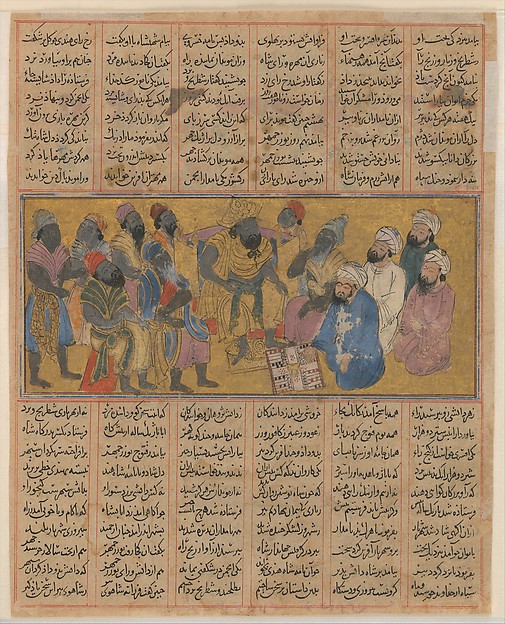
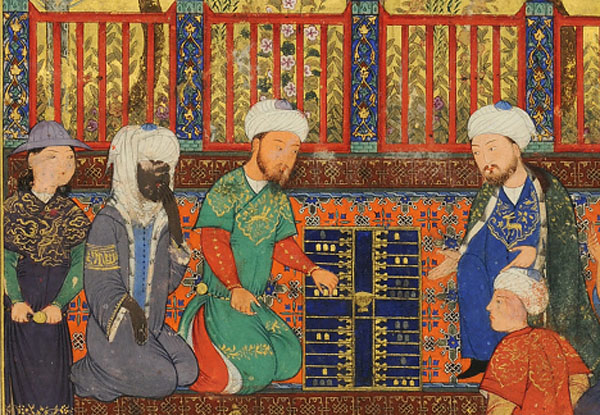
Neither can I absolutely confirm that a game almost identical to modern backgammon was played.  BUT, the evidence strongly supports the assertion that it was.  Let me lay this out for you.  Language is tricky and I cannot offer any written evidence that the tables game reference in the writings above is modern backgammon.  I have, therefore, relied upon visual sources.  There are three images in particular.

Image 1

Image 1 is a very early 14th Century image held by the Metropolitan Museum of Art.  You can see it here.  This is a relation of the origin myth of backgammon showing the diplomat/adviser Burzoe instructing the King of India in the game.  The game pieces are red and black on a white board (which is interesting in and of itself) and the pieces are distributed in a fashion that very strongly resembles the starting distribution of pieces in modern backgammon.

Image 2

Image 2 is a close up of a 15th Century illumination in the Anthology of Baysunghur in the Berenson Collection in the Villa I Tatti.  Here we see princes playing at tables and, again, the distribution of the pieces very strongly resembles the starting distribution of pieces in modern backgammon.

Image 3

Finally we have Image 3 which is a 16th Century Turkish illumination depicting Burzoe demonstrating chess to King Khusraw.  This piece is held by the Los Angeles County Museum of Art.  Note, again, the distribution of pieces.

The distribution of pieces is important because it is unique amongst the games that we know about and we have a fairly extensive knowledge of tables games from European sources.  This distribution is highly unlikely, but not impossible, to occur playing any of the other variations of tables games.  On this basis I feel confident that someone at an SCA event playing modern backgammon, leaving out the doubling cube and the doubles rule, would not be far wrong at all.

Before I end this I'd like to point out a couple of other things I find interesting.  Some of you will have noted the distinctive shape of the boards which visually distinguishes them from European style boards.  You may also have noted the cups in the center of the boards in Image 1 and 2.  I speculate that this cup was used for the dice and they were either cast into it or kept in the cup and the entire cup shaken and then set down. And last, since all the scenes depict the rich and powerful the boards are, accordingly, quite large.  I have no idea what boards for the less wealthy might have looked like.  These images don't provide us with any evidence for the number of dice that would be used in play.  I suspect two dice were used based on the listing of backgammon equipment provided by the 10th Century writer Mas'udi, but I cannot be certain of this number of the basis of this sparse evidence.

I also want to remind you that I have the rules for many tables games and, more importantly, the sources they are derived from in a PDF booklet here.  You can find a set of rules for Todas Tablas, which is the game I believe we are seeing, in this booklet.

Tuesday, June 16, 2015

Tables Games

As I've noted, my commonplace book of a blog has become more of a diary than an actual commonplace book.  That function, gathering together useful bits of information, has been taken over by Google Drive.  I really like Google Drive.

But in looking back on my posts (both of them) I saw that I had started talking about backgammon and tables games and never really finished.  I have finished.  I've compiled a bunch of references and learned quite a lot about tables games in the Middle Ages.  Long before playing cards make their appearance in the 14th Century and become wildly popular in the 15th tables games were cock of the walk.  Chess, being entirely based on skill, was popular primarily with the upper classes.  Dice, being entirely based on luck (unless you were cheating), was popular primarily with the lower classes.  The relative costs of the gaming equipment required helped to cement this. Tables games, on the third hand, combined elements of chance and skill in varying degrees and were wildly popular with both segments of the population.

I've compiled the rules for 19 distinct tables games (which includes Backgammon) and an additional 5 variations on those games.  My list is by no means exhaustive but I think I've hit on the more common games and variants for which rules are available.  Rather than type everything out, again, I'm just going to point you to the booklet I prepared:

https://drive.google.com/file/d/0B15SAMYZtejMV3VVNllCME95U2M/view?usp=sharing

And now I'll offer some random comments:

-Although it seems strange, I really like the games that allow you to declare your rolls rather than actually rolling dice.  While this eliminates chance from the game, it's very interesting to occasionally play tables games as exercises in pure skill.

-I was fascinated to discover that people would set up tables game problems, like chess or go problems, and then wager that people couldn't solve the problems.  These were, again, pure skill puzzles and trying to understand and solve them seems like an exercise in touching the middle ages.

-Although the booklet doesn't cover game boards, I think finding the wide variety of gameboards out there was one of the bigger pleasures of my research.  They varied from humble scratchings on wood and ivory to massively inlaid treasures.  The variations in design were also interesting to see.

-The sheer variety of games, and the complexity of the rules, was astounding.  The booklet was less an attempt to share my research than it was to make a document I could refer to in order to refresh my memory when I wanted to play a game.  In looking at these games, and early playing card games, I am struck by how much time the players must have been taking.  In general it seems that the idea of a quick game was known but not entirely popular.

-Fallas threw me for a loop.  I didn't understand it at all until I realized it's a game that's played to not lose rather than to win.  I've never played a game of this that ended with someone getting all their pieces off the board.  Positioning yourself to have lots of moves, and to take away your opponent's ability to move, is the object of the game and players who realize this tend to win.

-I *REALLY* want to find a documented game from the Islamic Middle Ages. We know the game was played (my favorite reference is a poet establishing his bad-boy cred by boasting about how he whiles away the days of Ramadan playing tables games) but we don't know the exact rules of any of the games they played.  I used two modern games with long established (18th Century) roots and one game I made up by using common rules and a starting position found in a 14th Century Persian illustration.

Monday, June 15, 2015

More playing cards. Paper, again.

Remember how I said the paper in playing cards was linen?  Yeah, about that...  With the caveat that we're talking about a very large geographical area and time frame: I was wrong.  Linen is only number two on the list of materials.  It appears that hemp is number one on the list.  I thought that linen rags constituted the largest ingredient that went into making paper but in fact it's the hemp material from sails and, more importantly, ropes that constituted the largest ingredient.

Again, big time frame and geographic area, but it appears that hemp is far and away the primary ingredient, supplemented by linen, and then by various other materials.  In every case the materials that went into paper were waste materials from other processes or products.  Mulberry material has been found in some papers, for example, and this was probably waste from the silk industry in Southern Europe.  Cotton fiber is mentioned as an ingredient, but the tow (the short fibers) rather than the long fiber material (called flax fibers) used for making clothing.  This from a source on Islamic paper composition.  I've even heard allegations, but not yet seen the references for myself, that hair and other waste fibers from animals went into paper production.

While the natural inclination, okay, my inclination, would be to assume that such paper would be rough and very much off-white and possessed of numerous irregularities this was apparently not the case.  Pulping was a very organized, if labor intensive, process with strict quality control.  Bleaching was a known process and was practiced.  Water was filtered to prevent contaminants from entering the process.  Paper was pressed, rolled/polished, and even given surface finishes using chalk.  One of the English conservation organizations I looked at noted that medieval paper, when new, bore a strong resemblance to 80gsm white printer paper in appearance and texture.  Colored paper was even in use.

Yeah, I know, you want references.  This blog isn't really about those; it's more of a place where I collect and share some of my thoughts and ideas.  Here are a few links:
http://paper.lib.uiowa.edu/european.php
https://www.saudiaramcoworld.com/issue/199903/revolution.by.the.ream-a.history.of.paper.htm
http://www.islamicmanuscripts.info/reference/books/Gaur-1994-Calligraphy/Gaur-1994-Calligraphy-032-055.pdf
http://britishlibrary.typepad.co.uk/collectioncare/2015/04/making-islamic-style-paper.html
http://www1.uni-hamburg.de/COMST/Bulletin1/pp69-70.pdf


I've been working with playing cards for several years now and I'm approaching what I consider a position of enlightened ignorance (I'm becoming aware of just how little I actually know).  I have experimented with techniques and I continue to experiment with techniques and I'll share some of the results here when I have the time and inclination.  For the past few years I've sort of been confined to doing print on demand using modern printers and modern materials.  Now I'm looking at moving past that and producing cards that are printed on paper that's more closely authentic.  In that search I've been looking for hemp, linen, and cotton papers of 300gsm that's not a brilliant white and is mostly smooth/polished.  It's been difficult to find at reasonable prices.  There are any number of high-end craft manufacturers out there who have been in business since the 17th or 18th centuries and will charge you accordingly (or so it seems) but more affordable paper has been hard to find.  Still, I keep looking.

I'm updating this because I've done more research but I don't want to start a new post.  I read a good analogy:  Trying to describe paper-making during the Middle Ages is like trying to describe cheese-making during the Middle Ages.  That really sums it up.  Indications are that paper-making was a sophisticated process (which means it had a lot of techniques to choose from and lots of ways those techniques could be varied) and the products produced by paper-makers could vary widely, even from the same manufacturer.  The documented sorting of fibers meant that manufacturers typically produced at least three grades of paper.   Treatment options for rags prior to pulping could lead to large variations in color. Variations in sizing (soaking the paper in gelatin and, possibly, other substances) could lead to differences in appearance and the way the paper reacted to inks.  And post manufacturing treatments such as burnishing could produce different textures.  All of this means that there's no effective way to say what paper for Medieval playing cards should have looked like.

I'm updating this again.  Remember, kids, always check the references.  Always. 

http://paper.lib.uiowa.edu/index.php#

This website has a link to their collection which has a large sampling of historical papers from the 14th Century on.

http://digital.lib.uiowa.edu/cdm/search/collection/paper/order/date

In looking through this I find that the average thickness of 14th-15th Century papers is: 0.22mm

Now I can check that with a reference source on paper weight (thickness).

http://www.paper-paper.com/weight.html

That tells me the paper in question is about a 199gsm

For comparison that's a modern cardstock.  That's almost as thick as the cardboard that makes up a box of breakfast cereal.  Because it is paper, not cardboard, however, it is considerably less stiff.  This is not as thick as premium calling-card stock, for instance.  By way of comparison, common copier/printer paper is usually around 70gsm.  That means these historical sheets of paper are almost three times as thick.